

A Great Awakening Started Here
by JD Byous
He didn’t start the flame, but he made it explode like the cannon fire of a unique revolution. When George Whitefield arrived in Georgia in 1738, the First Great Awakening was already flickering in New England under leaders like Jonathan Edwards. But those early revivals were limited, they were local, fragmented, and lacking momentum. Whitefield changed that. Through his electrifying preaching, relentless travel, and growing influence in Savannah, he transformed a regional religious revival into a mass, trans-colonial movement that reshaped American Christianity. Estimates are that from twenty-five to eighty-five percent of the population in the American colonies heard George Whitefield’s sermon over the years.
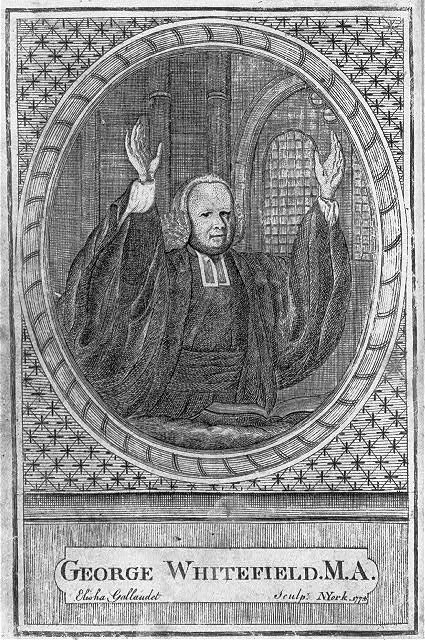
The First Great Awakening
Savannah became a critical southern anchor of the Great Awakening, where Whitefield’s message of the “new birth,” combined with his founding of the Bethesda Orphan House, gave the movement both spiritual force and institutional presence. What began as scattered revivals in New England evolved—through Whitefield’s reach—into a connected, continent-spanning phenomenon that helped redefine religious authority, unify the colonies through shared experience, and lay early cultural groundwork for an emerging American identity.
The First Great Awakening, a defining moment in early American religious history, unfolded across the colonies during the 1730s and 1740s. It was part of a broader Evangelical Revival sweeping Britain and the Atlantic world, yet in colonial America it developed unique characteristics shaped by distance from authority, denominational fragmentation, and frontier conditions. In Georgia, then the youngest and most experimental of the colonies, the Awakening was not just a wave of preaching; it became embedded in the colony’s very identity through Whitefield’s sustained presence and institutional efforts.
George Whitefield’s connection to Savannah was not incidental. Unlike many itinerant preachers who passed through briefly, Whitefield returned repeatedly and invested heavily in the colony’s development. His most enduring contribution was the founding of the Bethesda Orphan House in 1740, located just outside Savannah. This institution was more than a charitable project; it was a physical expression of his theology. Whitefield believed that true Christianity required both personal conversion and active benevolence, and the orphanage became a centerpiece of his ministry in America. Funds for Bethesda were raised through his extensive preaching tours, linking Savannah directly to audiences across the colonies and even in Britain.
Whitefield’s preaching in Savannah reflected the same theological core he carried throughout the Atlantic world. At the heart of his message was the doctrine of the “new birth,” the insistence that individuals must experience a personal, transformative encounter with God. This emphasis cut against the grain of established colonial religion, particularly in Anglican contexts where church membership and sacramental participation were often seen as sufficient markers of faith. Whitefield rejected this notion outright. He argued that outward conformity meant nothing without inward change, a position that both attracted large audiences and provoked sharp criticism from established clergy.
Whitefield’s Influence
What made Whitefield particularly effective in Savannah and beyond was not just what he preached, but how he preached. His sermons were theatrical, emotionally charged, and designed to engage listeners at a visceral level. He used vivid imagery, dramatic pauses, and direct appeals to the listener’s conscience. This style was well suited to outdoor preaching, which became his trademark. In Savannah, as in Philadelphia, Boston, and other cities, Whitefield often spoke to crowds that far exceeded the capacity of any church building. His ability to project his voice and command attention turned preaching into a mass experience, something closer to public performance than traditional liturgy.
Whitefield’s influence extended far beyond Georgia through his relationship with Benjamin Franklin. Franklin, though not a convert to Whitefield’s theology, recognized his extraordinary ability as a communicator and promoter. During Whitefield’s visits to Philadelphia, Franklin printed his sermons and journals, helping to disseminate them throughout the colonies. Franklin also famously conducted informal experiments to estimate how many people could hear Whitefield speak, concluding that his voice could carry to thousands in open air, some suspect to crowds of twenty to thirty-thousand people This collaboration between preacher and printer was critical to the spread of the Great Awakening. It transformed Whitefield into one of the first transatlantic media figures, with his sermons reaching audiences far beyond those who heard him in person.
The Savannah connection remained central to Whitefield’s identity even as he traveled. He frequently referred to Bethesda in his sermons, using it as both a fundraising cause and a moral example. This created a feedback loop: audiences in northern colonies and Britain contributed to a project in Georgia, while the success of that project reinforced Whitefield’s credibility and mission. In this way, Savannah became a focal point in a much larger network of evangelical activity.
Theologically, Whitefield’s message was rooted in Calvinism, particularly the doctrines of human sinfulness, divine grace, and predestination. However, his emphasis was less on abstract theology and more on the experience of conversion. He sought to bring listeners to a moment of crisis, a realization of their spiritual condition followed by a call to repentance. This approach aligned him with other revivalists, including Jonathan Edwards, though Edwards operated primarily in New England and with a more intellectual style. While Edwards analyzed the nature of religious experience in works like Religious Affections, Whitefield embodied it in his preaching.
The impact of Whitefield’s ministry in Savannah must also be understood within the broader social context of Georgia. Founded in 1733 as a philanthropic experiment under James Oglethorpe, the colony initially prohibited slavery and sought to create a society of small farmers. By the time Whitefield was active there, these ideals were already under pressure. Whitefield himself became entangled in this controversy, eventually advocating for the legalization of slavery in Georgia, partly to support the economic sustainability of the orphanage. This position has been the subject of significant historical debate and criticism, as it stands in tension with the revivalist emphasis on spiritual equality. It underscores a central contradiction of the Great Awakening: its theology could inspire ideas of equality and individual worth, yet its leaders often operated within, and sometimes reinforced, existing social hierarchies.
Diversity of His Audiences
Despite these contradictions, the Awakening in Savannah shared key themes with the broader movement. One of the most important was the challenge to religious authority. Whitefield openly criticized ministers he considered “unconverted,” echoing arguments made by figures like Gilbert Tennent in the northern colonies. This critique undermined the legitimacy of established clergy and encouraged laypeople to evaluate religious leaders based on their perceived spiritual authenticity rather than their institutional position.
Another critical theme was the democratization of religious experience. In Savannah, as elsewhere, Whitefield’s preaching drew diverse audiences, including individuals who might not have been fully integrated into formal church life. While the extent of participation by enslaved Africans and marginalized groups varied, the very structure of outdoor preaching made it more accessible than traditional services. This accessibility reinforced the idea that salvation was not restricted by class, education, or status.
The Awakening also contributed to the development of a shared colonial culture, and Savannah played a role in this process through Whitefield’s network. His repeated journeys between Georgia and other colonies created connections that transcended regional boundaries. Colonists who contributed to Bethesda or read Whitefield’s printed sermons were participating in a common religious movement, even if they never traveled far from home. This sense of connection was new in a colonial world, often defined by isolation and localism.
At the same time, the movement generated resistance. In Georgia, as in other colonies, some clergy and officials viewed Whitefield’s methods as disruptive. His criticism of established ministers and his tendency to draw large, emotionally engaged crowds raised concerns about order and authority. These tensions mirrored broader divisions between “New Lights,” who supported the revival, and “Old Lights,” who opposed it. The resulting conflicts were not merely theological; they were also about control; about who had the right to speak, to lead, and to define religious truth.
Effects
The relationship between the First Great Awakening and the American Revolution remains a subject of ongoing scholarly debate. It is inaccurate to claim that Whitefield or his contemporaries directly advocated for political independence. Whitefield himself remained loyal to the British Crown. However, the intellectual and cultural effects of his preaching are harder to dismiss. By encouraging individuals to question religious authority and rely on personal judgment, the Awakening contributed to a broader shift in how authority was understood.
In Savannah, this shift was particularly significant because of the colony’s relative youth and fluid social structure. Without the deeply entrenched institutions found in older colonies, Georgia was more open to new ideas and forms of organization. Whitefield’s influence helped shape a religious culture that valued personal conviction and moral accountability, traits that would later resonate in political contexts.
The partnership between Whitefield and Franklin further amplified these effects. Franklin’s printing press ensured that Whitefield’s ideas reached a wide audience, while Whitefield’s popularity provided Franklin with profitable material. This relationship illustrates how the Great Awakening was not only a movement but also a media phenomenon, leveraging print culture to spread its message. The circulation of sermons, journals, and pamphlets created a shared discourse that connected disparate communities.
By the mid-eighteenth century, the legacy of Whitefield’s work in Savannah and beyond was firmly established. The Bethesda Orphan House continued to operate, serving as a lasting reminder of his presence in Georgia. More broadly, the Awakening had reshaped American Protestantism, emphasizing personal conversion, emotional engagement, and the authority of Scripture. These themes would continue to influence religious life for generations.
His Call to Action
The First Great Awakening, when viewed through the lens of Savannah and George Whitefield’s ministry, reveals itself as more than a series of revivals. It was a transformative moment in American history that redefined the relationship between individuals and authority. In Savannah, this transformation was grounded in both preaching and practice, in sermons that called for the new birth and in institutions like Bethesda that embodied a new vision of Christian responsibility.
Ultimately, the significance of Whitefield’s work lies not in any single sermon or event, but in the cumulative effect of his ministry. By the time the colonies moved toward revolution in the latter half of the eighteenth century, many Americans had already internalized a new way of thinking, one that emphasized personal judgment, moral accountability, and the right to question authority. These ideas did not originate solely with Whitefield, but his role in spreading and popularizing them was unmatched.
The story of the First Great Awakening in Savannah is therefore not a peripheral chapter in American history; it is central to understanding how a collection of colonies began to develop a shared identity and a willingness to challenge established power. Through his preaching, his philanthropy, and his partnership with figures like Benjamin Franklin, George Whitefield helped create a movement that reached far beyond the pulpit, into the cultural and intellectual foundations of what would become the United States.
Endnotes
Thomas S. Kidd, The Great Awakening: The Roots of Evangelical Christianity in Colonial America (New Haven: Yale University Press, 2007).
Patricia U. Bonomi, Under the Cope of Heaven: Religion, Society, and Politics in Colonial America (New York: Oxford University Press, 1986).
Harry S. Stout, The Divine Dramatist: George Whitefield and the Rise of Modern Evangelicalism (Grand Rapids: Eerdmans, 1991).
Mark A. Noll, America’s God: From Jonathan Edwards to Abraham Lincoln (New York: Oxford University Press, 2002).
George Whitefield, Journals of George Whitefield (various 18th-century editions and modern reprints).
Benjamin Franklin, The Autobiography of Benjamin Franklin (various editions), sections on Whitefield.
Rhys Isaac, The Transformation of Virginia, 1740–1790 (Chapel Hill: University of North Carolina Press, 1982).
Alan Heimert, Religion and the American Mind (Cambridge, MA: Harvard University Press, 1966).
Jonathan Edwards, A Faithful Narrative of the Surprising Work of God (1737; repr., various editions).
Sav
AFFILIATE LINKS for touring and learning:
Guided Segway Tours - at Adventure Tours In Motion (Use LOH for 10% discount at checkout)
Guided Bike Tours - at Savannah Bike Tours (Use LOH for 10% discount at checkout)
AFFILIATE LINKS for products I use making our videos:
As an Amazon Associate I earn from qualifying purchases.
Below is the equipment I use all the time:
Nikon D7200 for still images
Nikon DR-6 Right Angle Viewfinder. Great for low shots with the D7200
Panasonic Lumix G7 for stills and video
Panasonic LUMIX GH4 also for stills and slow motion video
Newer 77 inch Tripod. Light weight for walking around town
Godox AD200 Pro Pocket Outdoor Flash Strobe, 200Ws 2.4G TTL 1/8000s HSS
Godox X2T-N Flash Trigger for Nikon
Godox X2T-O TTL Wireless Flash Trigger for Olympus Panasonic
DJI Osmo Mobile SE, 3-Axis Gimbal for iPhone, Android. (I use this all the time)
RØDE Wireless ME Ultra-compact Wireless Microphone System
Visual Archaeology in Savannah’s Reynolds Square
JD Byous
In historic cities, the past rarely disappears completely. It lingers in brick seams, buried foundations, altered facades, and street lines that no longer make sense. The clues are everywhere, but most people walk past them without noticing. Historians and archaeologists have a name for this type of observation: visual archaeology — the study of the physical traces of earlier landscapes that remain visible in the modern built environment.
Visual archaeology does not replace traditional excavation. Instead, it complements it. Where conventional archaeology digs into the ground, visual archaeology studies the surface: architecture, street layouts, scars in brickwork, and the subtle “ghosts” left behind when buildings change over time. A careful observer can often reconstruct decades — or even centuries — of urban transformation simply by reading these visible clues.
Few American cities reward this type of investigation more than Savannah. Founded in 1733 and famous for its orderly plan of wards and squares, Savannah preserves a layered architectural landscape that stretches from the colonial era to the modern day. Within its historic district, entire stories remain hidden in plain sight. One of the best places to see this layered history is Reynolds Square, where eighteenth-century buildings, nineteenth-century commercial growth, and twentieth-century redevelopment all intersect within a few hundred feet.
By examining the square closely, its buildings, sidewalks, and walls, it becomes possible to reconstruct fragments of Savannah’s past without lifting a single shovel.
The Idea Behind Visual Archaeology
Archaeology is often imagined as an excavation: trowels, trenches, and buried artifacts. Yet the discipline has long relied on observation as much as digging. Architectural historians, for example, routinely interpret structures by reading their fabric, examining mortar types, brick colors, nail styles, or framing methods to determine when different portions of a building were constructed.
Visual archaeology expands that approach beyond individual buildings to the broader urban landscape. It treats the city itself as a document. Cracks in pavement may mark former property lines. Bricked-up doorways can reveal earlier floor plans. Changes in masonry often indicate additions, demolitions, or shifts in land use.
In places with long histories of redevelopment, these traces accumulate. They become what preservationists often call architectural ghosts— features that remain visible even after the structures that created them have disappeared. Savannah’s historic district contains hundreds of these ghosts. Reynolds Square provides a compact case study of how they work.
Reynolds Square: A Colonial Framework
Reynolds Square dates to the earliest years of Savannah’s founding. The city’s distinctive ward plan — laid out under the leadership of colonial founder James Edward Oglethorpe, organized neighborhoods around central squares. Each ward contained residential lots, civic trust lots, and an open public square designed as a communal space.
Reynolds Square emerged within this framework during the eighteenth century and soon became an important civic and religious center. One of its most significant early occupants was the Anglican minister John Wesley, who lived nearby during his brief but influential ministry in Georgia in 1736–1737.¹
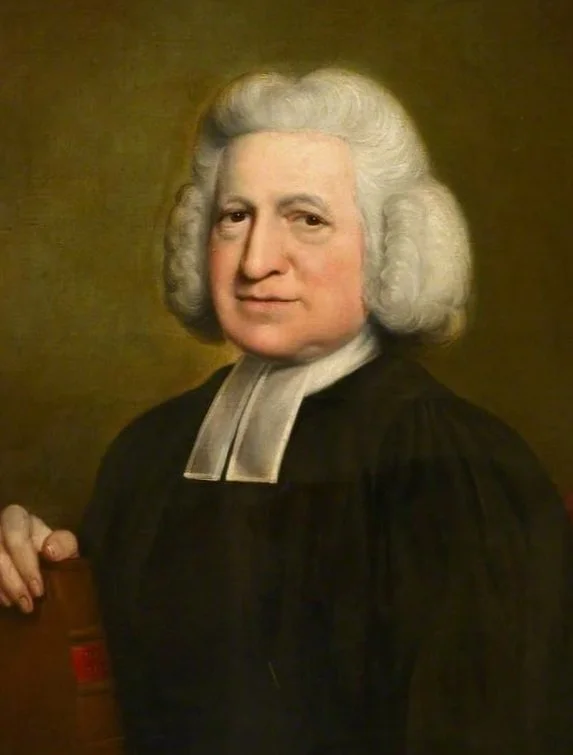
John Wesley, Founder of Methodism
Although the original structures from Wesley’s time have disappeared, the site itself retains continuity. Later buildings were constructed atop or adjacent to earlier ones, preserving layers of occupation that can still be detected in the surrounding architecture.
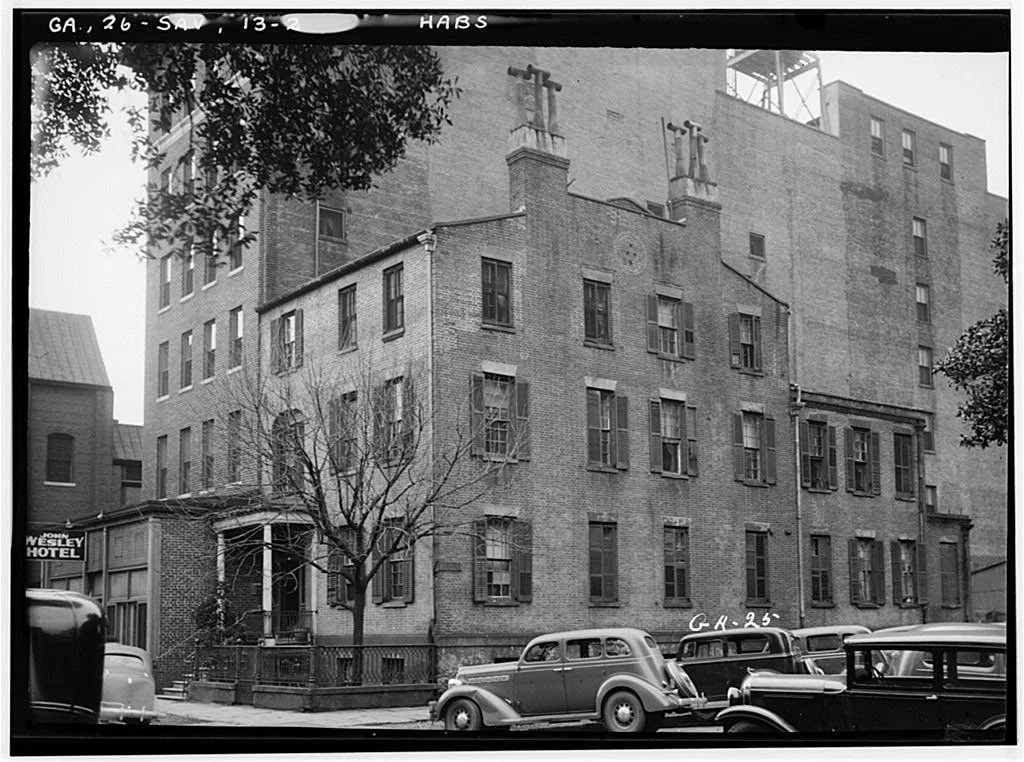
The Oliver Sturges House December 30 1936. L.D. Andrew Photographer
The Oliver Sturges House: Commerce and Steam Power
One of the most prominent structures facing the square today is the Oliver Sturges House at 27 Abercorn Street. Built around 1813, the house stands as an elegant example of Federal-style urban architecture.²
Its builder, Oliver Sturges, was a Connecticut-born merchant who became a major figure in Savannah’s early nineteenth-century commercial life. After moving south in the early 1800s, Sturges entered the cotton trade and built partnerships with other merchants operating in the Atlantic economy.³
Sturges is remembered today for his involvement with the pioneering steamship SS Savannah. The vessel achieved global fame in 1819 when it completed the first transatlantic voyage by a steam-powered ship. While the crossing relied partly on sails, the journey demonstrated that steam propulsion could successfully operate across the ocean.⁴
Historical accounts indicate that planning for the ship’s voyage took place within Sturges’s Reynolds Square residence.⁵ In that sense, the building became an unlikely headquarters for one of the early milestones in maritime engineering.
Architecturally, the house also illustrates the development of Savannah itself. The structure originally stood beside a nearly identical companion house belonging to Sturges’s business partner, Benjamin Burroughs. Over time the neighboring building disappeared, replaced by later construction associated with the Planters Inn.⁶
Today the Sturges House survives as the headquarters of Morris Multimedia and is listed on the National Register of Historic Places.⁷
Ghosts in Brick and Mortar
Behind the Sturges House lies a quieter but equally revealing archaeological landscape. In the courtyard walls and adjacent structures, careful observers can see subtle changes in brick color, blocked openings, and irregular masonry lines. These features represent successive modifications made to the property over more than two centuries.
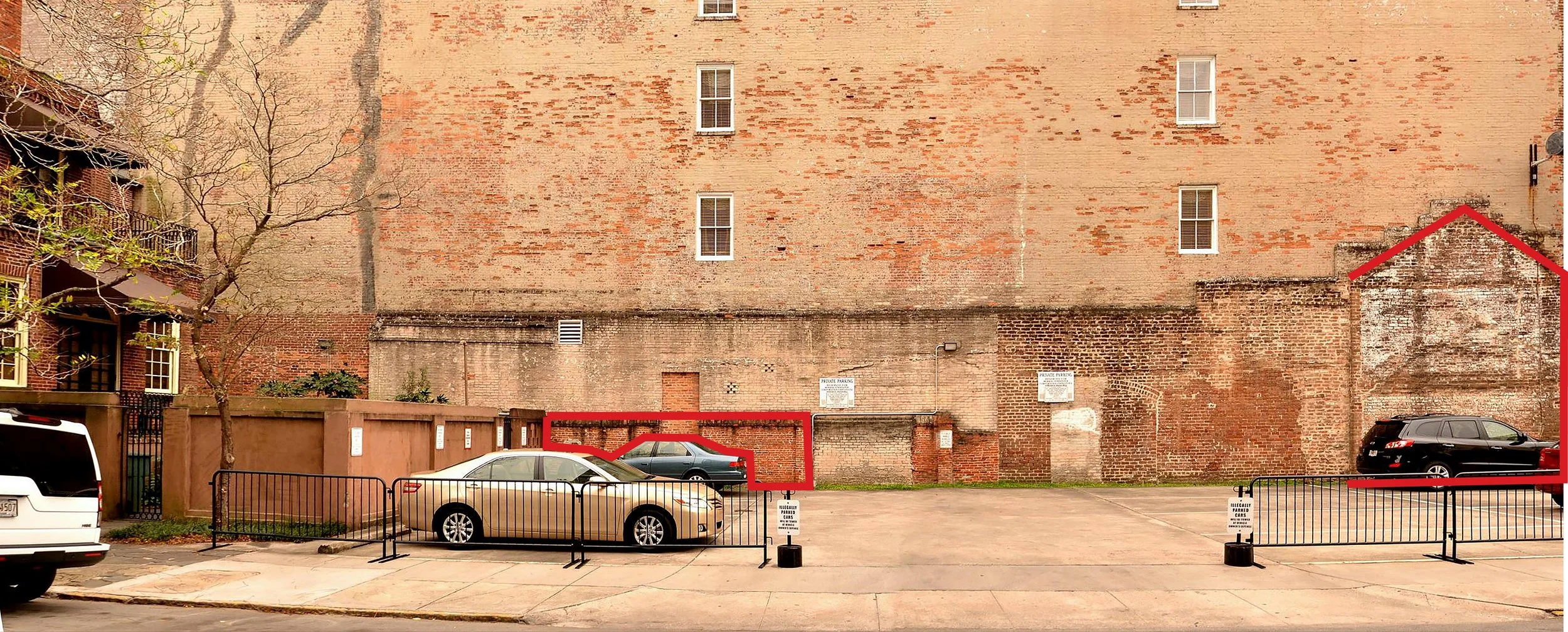
The parking area of the Oliver Sturges House on Reynolds Square with architecural “ghosts.”
A short brick wall near the rear of the lot likely represents part of the early nineteenth-century garden enclosure that once surrounded the residence. In many urban houses of the period, carriage houses and service buildings stood behind the main structure, separated from the street by enclosed yards.
Where those auxiliary buildings once stood, faint outlines sometimes remain visible. Bricked-up doors and arches can reveal where interior spaces were reorganized or where demolished structures once attached to standing walls. In preservation terminology these marks are often called “ghosts” because they record the presence of something that is no longer there.
Urban historians rely heavily on these clues. By comparing masonry patterns and consulting historical maps, they can reconstruct building phases that would otherwise be lost.
The Olde Pink House: A Survivor from the Colonial Era
Across the street from the Sturges House stands another landmark of Reynolds Square: the The Olde Pink House.
Originally built in 1771 for merchant and planter James Habersham Jr., the Georgian-style mansion ranks among the oldest surviving structures in the city.⁸ Habersham belonged to one of colonial Georgia’s most influential families, deeply involved in commerce and government during the eighteenth century.
The building has served many purposes across its long life. After functioning as a private residence, it became the headquarters of the Planters Bank in 1812 and is often described as Georgia’s first bank.⁹ During the Civil War the building also served as a Union military headquarters.¹⁰
By the twentieth century, the house passed through a series of commercial uses, including an attorney’s office and bookstore. In the 1930s it became a tea room operated by preservationist Alida Harper Fowlkes.¹¹
Today the structure operates as a well-known Savannah restaurant, drawing visitors from around the world.
Why the Olde Pink House Is Pink
The building’s distinctive color has produced more than a few myths. One commonly repeated story claims that the house turned pink because red bricks bled through white plaster over time. In reality, the explanation is less complicated.
The myth about the building says it was constructed of red brick and later, coated with plaster. Over time, weathering and repainting altered its appearance. At various points owners painted the exterior white, while later restorations embraced the now-iconic pink color. If you’ve ever worked in construction you can see the problem with that explanation. Brick colors do not bleed through plaster.¹²
The reality is much simpler. Alida Harper-Fowlkes, the lady who operated the Pink House as a tea room and restaurant in the late 1930s, had the building painted… well… pink. Over the years it has been painted with many variations of that color. It is a local favorite and is a famous destination for Savannah visitors today. Lens on History Producer, Becky Byous particularly loves the She-crab soup.
Whatever the building’s origin, the hue has become inseparable from the building’s identity. Today the mansion stands as one of Savannah’s most recognizable architectural landmarks.
Reading the Streets
Visual archaeology does not stop at building walls. Streets and sidewalks also preserve traces of earlier infrastructure.
In the block surrounding Reynolds Square, cast-iron utility covers and drainage structures date to the nineteenth century, when Savannah modernized its urban services. As sidewalks expanded and roadways were altered, additional layers of pavement and infrastructure accumulated.
In front of the Olde Pink House Restaurant are two manhole covers. This archeological feature remembers when the curb was closer to the building. Some time in the mid-twentieth century the city’s easement was extended, making the street more narrow. When the curb was moved it was necessary to add another storm drain. The original drain was simply built around, leaving it in the slate sidewalk.
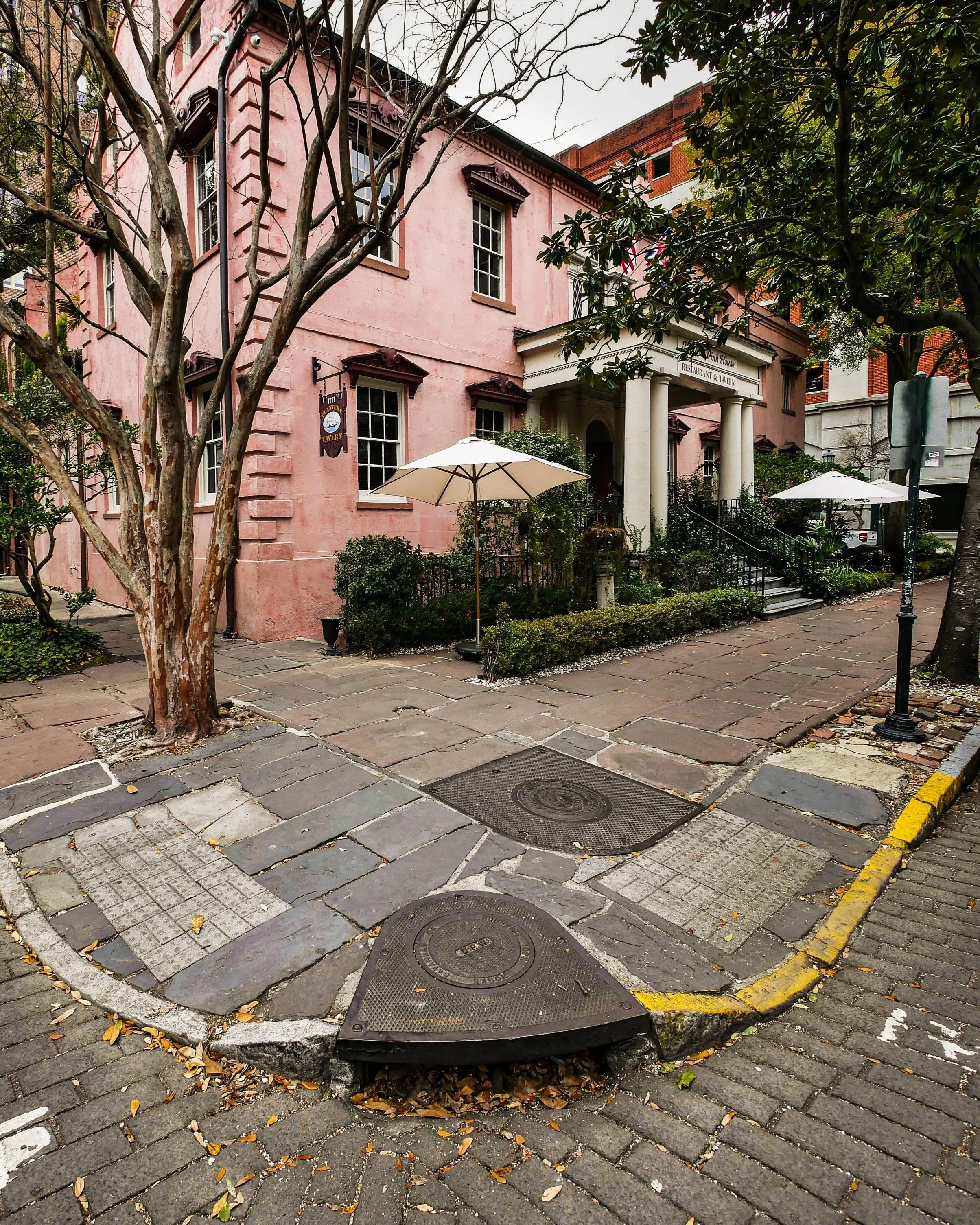
Changes in curb lines or paving materials sometimes indicate earlier street alignments. In cities with long histories of transit systems, subtle undulations in the roadway can even reflect buried rails or foundations left behind after trolley lines were removed.
Although such features require confirmation through documentary evidence or excavation, they illustrate the principle of visual archaeology: even everyday infrastructure can preserve physical evidence of the past.
The Value of Looking Closely
Cities like Savannah often appear timeless, but their landscapes are products of constant change. Buildings rise and fall, property boundaries shift, and transportation systems evolve. Each transformation leaves physical marks behind.
For historians, these marks provide invaluable evidence. Architectural ghosts reveal how buildings were expanded or repurposed. Street seams expose earlier urban layouts. Even the color variations in brickwork can tell a story about repairs, additions, or lost structures.
Reynolds Square offers a particularly vivid example of this layered history. Within a single block, one can see the legacy of colonial settlement, the growth of nineteenth-century commerce, and the preservation movement that saved many historic buildings during the twentieth century.
Savannah as an Open-Air Archive
Perhaps the greatest lesson of visual archaeology is that history is not confined to archives or museums. It exists all around us, embedded in the built environment.
In Savannah, the city itself functions as an open-air archive. Each square, each facade, and each lane preserves fragments of earlier eras. The challenge is learning how to read them.
Visitors who slow down and examine the details — brick seams, bricked-up windows, irregular sidewalks — often discover stories invisible at first glance. These features may not be dramatic like a buried artifact, but they offer something equally valuable: evidence of how real places evolve over time.
Reynolds Square, with its colonial houses, nineteenth-century commercial history, and subtle architectural ghosts, demonstrates that the past rarely disappears completely. Instead, it remains etched into the landscape, waiting for careful observers to notice it.
Footnotes
John Wesley resided in Savannah as an Anglican missionary from 1736–1737; see Frederick V. Mills Sr., Bishops by Ballot: An Eighteenth-Century Ecclesiastical Revolution (Oxford: Oxford University Press, 1978).
Deirdre Stanforth, Restored America: Old Towns and Cities in the United States (New York: Praeger, 1975), 173–175.
William Harden, A History of Savannah and South Georgia, vol. 1 (Chicago: Lewis Publishing Company, 1913), 406–408.
Frank Osborn Braynard, S.S. Savannah: The Elegant Steam Ship (Athens: University of Georgia Press, 1963).
Historic American Buildings Survey, “Hiram Roberts House (Oliver Sturges House), Savannah, Georgia,” Library of Congress.
Whip Morrison Triplett, Savannah: A Photographic Portrait (Charleston: Arcadia Publishing, 2006).
National Register of Historic Places, “Oliver Sturges House,” U.S. Department of the Interior.
Jedidiah Morse, American Gazetteer (Boston: S. Hall and Thomas & Andrews, 1797).
Telfair Museums, 200 Years of William Jay Architecture (Savannah: Telfair Museums, 2019).
Robert S. Davis Jr., Civil War Savannah (Macon: Mercer University Press, 2004).
Alida Harper Fowlkes preservation activities documented in local preservation records; see Historic Savannah Foundation archives.
Visit Savannah, “Why the Olde Pink House Is Pink,” Savannah Convention & Visitors Bureau.
Sav
AFFILIATE LINKS for touring and learning:
Guided Segway Tours - at Adventure Tours In Motion (Use LOH for 10% discount at checkout)
Guided Bike Tours - at Savannah Bike Tours (Use LOH for 10% discount at checkout)
AFFILIATE LINKS for products I use making our videos:
As an Amazon Associate I earn from qualifying purchases.
Below is the equipment I use all the time:
Nikon D7200 for still images
Nikon DR-6 Right Angle Viewfinder. Great for low shots with the D7200
Panasonic Lumix G7 for stills and video
Panasonic LUMIX GH4 also for stills and slow motion video
Newer 77 inch Tripod. Light weight for walking around town
Godox AD200 Pro Pocket Outdoor Flash Strobe, 200Ws 2.4G TTL 1/8000s HSS
Godox X2T-N Flash Trigger for Nikon
Godox X2T-O TTL Wireless Flash Trigger for Olympus Panasonic
DJI Osmo Mobile SE, 3-Axis Gimbal for iPhone, Android. (I use this all the time)
RØDE Wireless ME Ultra-compact Wireless Microphone System , Georgia, history, archaeology, photography, travel, architecture, historic, Reynolds, square, colonial, American, heritage, tourism, landmarks, preservation, urban, museum, culture, Lowcountry visual archaeology Savannah, hidden history Savannah Georgia, Reynolds Square Savannah, story, Olde Pink House history, Oliver Sturges House Savannah, Savannah ghost architecture, Savannah historic district tour, things to do in Savannah history lovers, Savannah colonial, history sites, Savannah architecture photography, historic Savannah travel guide, Savannah, squares history, urban archaeology Savannah, Savannah trolley history, historic landmarks in Savannah Georgia, Lens on History Savannah, Savannah hidden landmarks, Savannah brick ghost buildings, how to find hidden history in cities, Savannah Georgia travel history #SavannahGeorgia #SavannahHistory #ReynoldsSquare
What is Lens on History
Lens on History is a visually driven history platform that brings the past into sharp focus—one place, one object, one forgotten story at a time.
Presented through video vlog-style episodes, our podcast, and our blog, Lens on History explores American history, Colonial America, and the 18th and 19th centuries by walking the streets, cemeteries, buildings, and landscapes where history actually happened. Each episode connects everyday objects, architectural details, and long-standing traditions to the real people who shaped them.
The project places a strong emphasis on Savannah, Georgia history and the broader Atlantic coastal world, while consistently widening the lens to include forgotten historical figures, overlooked communities, and stories rarely told in textbooks. Rather than abstract timelines, the focus is on physical evidence, grave markers, headboards, brickwork, woodwork, street layouts, and surviving structures that still speak for themselves today.
Lens on History is created for curious minds: history enthusiasts, educators, travelers, preservationists, and anyone searching for hidden history, early American life, and the authentic stories behind historic places. The vlog format keeps the experience personal and accessible, inviting viewers to explore alongside the host as questions are asked, sources are examined, and conclusions are formed in real time.
We help you find hidden history, record it, and enjoy your visit in Savannah, Georgia.
AFFILIATE LINKS for touring and learning:
Guided Segway Tours - at Adventure Tours In Motion (Use LOH for 10% discount at checkout)
Guided Bike Tours - at Savannah Bike Tours (Use LOH for 10% discount at checkout)
AFFILIATE LINKS for products I use making our videos:
As an Amazon Associate I earn from qualifying purchases.
Below is the equipment I use all the time:
Nikon D7200 for still images
Nikon DR-6 Right Angle Viewfinder. Great for low shots with the D7200
Panasonic Lumix G7 for stills and video
Panasonic LUMIX GH4 also for stills and slow motion video
Newer 77 inch Tripod. Light weight for walking around town
Godox AD200 Pro Pocket Outdoor Flash Strobe, 200Ws 2.4G TTL 1/8000s HSS
Godox X2T-N Flash Trigger for Nikon
Godox X2T-O TTL Wireless Flash Trigger for Olympus Panasonic
DJI Osmo Mobile SE, 3-Axis Gimbal for iPhone, Android. (I use this all the time)
RØDE Wireless ME Ultra-compact Wireless Microphone System