

A Great Awakening Started Here
by JD Byous
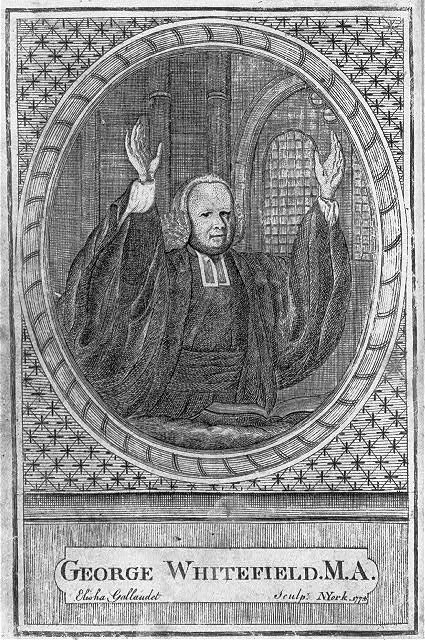
He didn’t start the flame, but he made it explode like the cannon fire of a unique revolution. When George Whitefield arrived in Georgia in 1738, the First Great Awakening was already flickering in New England under leaders like Jonathan Edwards. But those early revivals were limited, they were local, fragmented, and lacking momentum. Whitefield changed that. Through his electrifying preaching, relentless travel, and growing influence in Savannah, he transformed a regional religious revival into a mass, trans-colonial movement that reshaped American Christianity. Estimates are that from twenty-five to eighty-five percent of the population in the American colonies heard George Whitefield’s sermon over the years.
The First Great Awakening
Savannah became a critical southern anchor of the Great Awakening, where Whitefield’s message of the “new birth,” combined with his founding of the Bethesda Orphan House, gave the movement both spiritual force and institutional presence. What began as scattered revivals in New England evolved—through Whitefield’s reach—into a connected, continent-spanning phenomenon that helped redefine religious authority, unify the colonies through shared experience, and lay early cultural groundwork for an emerging American identity.
The First Great Awakening, a defining moment in early American religious history, unfolded across the colonies during the 1730s and 1740s. It was part of a broader Evangelical Revival sweeping Britain and the Atlantic world, yet in colonial America it developed unique characteristics shaped by distance from authority, denominational fragmentation, and frontier conditions. In Georgia, then the youngest and most experimental of the colonies, the Awakening was not just a wave of preaching; it became embedded in the colony’s very identity through Whitefield’s sustained presence and institutional efforts.
George Whitefield’s connection to Savannah was not incidental. Unlike many itinerant preachers who passed through briefly, Whitefield returned repeatedly and invested heavily in the colony’s development. His most enduring contribution was the founding of the Bethesda Orphan House in 1740, located just outside Savannah. This institution was more than a charitable project; it was a physical expression of his theology. Whitefield believed that true Christianity required both personal conversion and active benevolence, and the orphanage became a centerpiece of his ministry in America. Funds for Bethesda were raised through his extensive preaching tours, linking Savannah directly to audiences across the colonies and even in Britain.
Whitefield’s preaching in Savannah reflected the same theological core he carried throughout the Atlantic world. At the heart of his message was the doctrine of the “new birth,” the insistence that individuals must experience a personal, transformative encounter with God. This emphasis cut against the grain of established colonial religion, particularly in Anglican contexts where church membership and sacramental participation were often seen as sufficient markers of faith. Whitefield rejected this notion outright. He argued that outward conformity meant nothing without inward change, a position that both attracted large audiences and provoked sharp criticism from established clergy.
Whitefield’s Influence
What made Whitefield particularly effective in Savannah and beyond was not just what he preached, but how he preached. His sermons were theatrical, emotionally charged, and designed to engage listeners at a visceral level. He used vivid imagery, dramatic pauses, and direct appeals to the listener’s conscience. This style was well suited to outdoor preaching, which became his trademark. In Savannah, as in Philadelphia, Boston, and other cities, Whitefield often spoke to crowds that far exceeded the capacity of any church building. His ability to project his voice and command attention turned preaching into a mass experience, something closer to public performance than traditional liturgy.
Whitefield’s influence extended far beyond Georgia through his relationship with Benjamin Franklin. Franklin, though not a convert to Whitefield’s theology, recognized his extraordinary ability as a communicator and promoter. During Whitefield’s visits to Philadelphia, Franklin printed his sermons and journals, helping to disseminate them throughout the colonies. Franklin also famously conducted informal experiments to estimate how many people could hear Whitefield speak, concluding that his voice could carry to thousands in open air, some suspect to crowds of twenty to thirty-thousand people This collaboration between preacher and printer was critical to the spread of the Great Awakening. It transformed Whitefield into one of the first transatlantic media figures, with his sermons reaching audiences far beyond those who heard him in person.
The Savannah connection remained central to Whitefield’s identity even as he traveled. He frequently referred to Bethesda in his sermons, using it as both a fundraising cause and a moral example. This created a feedback loop: audiences in northern colonies and Britain contributed to a project in Georgia, while the success of that project reinforced Whitefield’s credibility and mission. In this way, Savannah became a focal point in a much larger network of evangelical activity.
Theologically, Whitefield’s message was rooted in Calvinism, particularly the doctrines of human sinfulness, divine grace, and predestination. However, his emphasis was less on abstract theology and more on the experience of conversion. He sought to bring listeners to a moment of crisis, a realization of their spiritual condition followed by a call to repentance. This approach aligned him with other revivalists, including Jonathan Edwards, though Edwards operated primarily in New England and with a more intellectual style. While Edwards analyzed the nature of religious experience in works like Religious Affections, Whitefield embodied it in his preaching.
The impact of Whitefield’s ministry in Savannah must also be understood within the broader social context of Georgia. Founded in 1733 as a philanthropic experiment under James Oglethorpe, the colony initially prohibited slavery and sought to create a society of small farmers. By the time Whitefield was active there, these ideals were already under pressure. Whitefield himself became entangled in this controversy, eventually advocating for the legalization of slavery in Georgia, partly to support the economic sustainability of the orphanage. This position has been the subject of significant historical debate and criticism, as it stands in tension with the revivalist emphasis on spiritual equality. It underscores a central contradiction of the Great Awakening: its theology could inspire ideas of equality and individual worth, yet its leaders often operated within, and sometimes reinforced, existing social hierarchies.
Diversity of His Audiences
Despite these contradictions, the Awakening in Savannah shared key themes with the broader movement. One of the most important was the challenge to religious authority. Whitefield openly criticized ministers he considered “unconverted,” echoing arguments made by figures like Gilbert Tennent in the northern colonies. This critique undermined the legitimacy of established clergy and encouraged laypeople to evaluate religious leaders based on their perceived spiritual authenticity rather than their institutional position.
Another critical theme was the democratization of religious experience. In Savannah, as elsewhere, Whitefield’s preaching drew diverse audiences, including individuals who might not have been fully integrated into formal church life. While the extent of participation by enslaved Africans and marginalized groups varied, the very structure of outdoor preaching made it more accessible than traditional services. This accessibility reinforced the idea that salvation was not restricted by class, education, or status.
The Awakening also contributed to the development of a shared colonial culture, and Savannah played a role in this process through Whitefield’s network. His repeated journeys between Georgia and other colonies created connections that transcended regional boundaries. Colonists who contributed to Bethesda or read Whitefield’s printed sermons were participating in a common religious movement, even if they never traveled far from home. This sense of connection was new in a colonial world, often defined by isolation and localism.
At the same time, the movement generated resistance. In Georgia, as in other colonies, some clergy and officials viewed Whitefield’s methods as disruptive. His criticism of established ministers and his tendency to draw large, emotionally engaged crowds raised concerns about order and authority. These tensions mirrored broader divisions between “New Lights,” who supported the revival, and “Old Lights,” who opposed it. The resulting conflicts were not merely theological; they were also about control; about who had the right to speak, to lead, and to define religious truth.
Effects
The relationship between the First Great Awakening and the American Revolution remains a subject of ongoing scholarly debate. It is inaccurate to claim that Whitefield or his contemporaries directly advocated for political independence. Whitefield himself remained loyal to the British Crown. However, the intellectual and cultural effects of his preaching are harder to dismiss. By encouraging individuals to question religious authority and rely on personal judgment, the Awakening contributed to a broader shift in how authority was understood.
In Savannah, this shift was particularly significant because of the colony’s relative youth and fluid social structure. Without the deeply entrenched institutions found in older colonies, Georgia was more open to new ideas and forms of organization. Whitefield’s influence helped shape a religious culture that valued personal conviction and moral accountability, traits that would later resonate in political contexts.
The partnership between Whitefield and Franklin further amplified these effects. Franklin’s printing press ensured that Whitefield’s ideas reached a wide audience, while Whitefield’s popularity provided Franklin with profitable material. This relationship illustrates how the Great Awakening was not only a movement but also a media phenomenon, leveraging print culture to spread its message. The circulation of sermons, journals, and pamphlets created a shared discourse that connected disparate communities.
By the mid-eighteenth century, the legacy of Whitefield’s work in Savannah and beyond was firmly established. The Bethesda Orphan House continued to operate, serving as a lasting reminder of his presence in Georgia. More broadly, the Awakening had reshaped American Protestantism, emphasizing personal conversion, emotional engagement, and the authority of Scripture. These themes would continue to influence religious life for generations.
His Call to Action
The First Great Awakening, when viewed through the lens of Savannah and George Whitefield’s ministry, reveals itself as more than a series of revivals. It was a transformative moment in American history that redefined the relationship between individuals and authority. In Savannah, this transformation was grounded in both preaching and practice, in sermons that called for the new birth and in institutions like Bethesda that embodied a new vision of Christian responsibility.
Ultimately, the significance of Whitefield’s work lies not in any single sermon or event, but in the cumulative effect of his ministry. By the time the colonies moved toward revolution in the latter half of the eighteenth century, many Americans had already internalized a new way of thinking, one that emphasized personal judgment, moral accountability, and the right to question authority. These ideas did not originate solely with Whitefield, but his role in spreading and popularizing them was unmatched.
The story of the First Great Awakening in Savannah is therefore not a peripheral chapter in American history; it is central to understanding how a collection of colonies began to develop a shared identity and a willingness to challenge established power. Through his preaching, his philanthropy, and his partnership with figures like Benjamin Franklin, George Whitefield helped create a movement that reached far beyond the pulpit, into the cultural and intellectual foundations of what would become the United States.
Endnotes
Thomas S. Kidd, The Great Awakening: The Roots of Evangelical Christianity in Colonial America (New Haven: Yale University Press, 2007).
Patricia U. Bonomi, Under the Cope of Heaven: Religion, Society, and Politics in Colonial America (New York: Oxford University Press, 1986).
Harry S. Stout, The Divine Dramatist: George Whitefield and the Rise of Modern Evangelicalism (Grand Rapids: Eerdmans, 1991).
Mark A. Noll, America’s God: From Jonathan Edwards to Abraham Lincoln (New York: Oxford University Press, 2002).
George Whitefield, Journals of George Whitefield (various 18th-century editions and modern reprints).
Benjamin Franklin, The Autobiography of Benjamin Franklin (various editions), sections on Whitefield.
Rhys Isaac, The Transformation of Virginia, 1740–1790 (Chapel Hill: University of North Carolina Press, 1982).
Alan Heimert, Religion and the American Mind (Cambridge, MA: Harvard University Press, 1966).
Jonathan Edwards, A Faithful Narrative of the Surprising Work of God (1737; repr., various editions).
Sav
AFFILIATE LINKS for touring and learning:
Guided Segway Tours - at Adventure Tours In Motion (Use LOH for 10% discount at checkout)
Guided Bike Tours - at Savannah Bike Tours (Use LOH for 10% discount at checkout)
AFFILIATE LINKS for products I use making our videos:
As an Amazon Associate I earn from qualifying purchases.
Below is the equipment I use all the time:
Nikon D7200 for still images
Nikon DR-6 Right Angle Viewfinder. Great for low shots with the D7200
Panasonic Lumix G7 for stills and video
Panasonic LUMIX GH4 also for stills and slow motion video
Newer 77 inch Tripod. Light weight for walking around town
Godox AD200 Pro Pocket Outdoor Flash Strobe, 200Ws 2.4G TTL 1/8000s HSS
Godox X2T-N Flash Trigger for Nikon
Godox X2T-O TTL Wireless Flash Trigger for Olympus Panasonic
DJI Osmo Mobile SE, 3-Axis Gimbal for iPhone, Android. (I use this all the time)
RØDE Wireless ME Ultra-compact Wireless Microphone System